
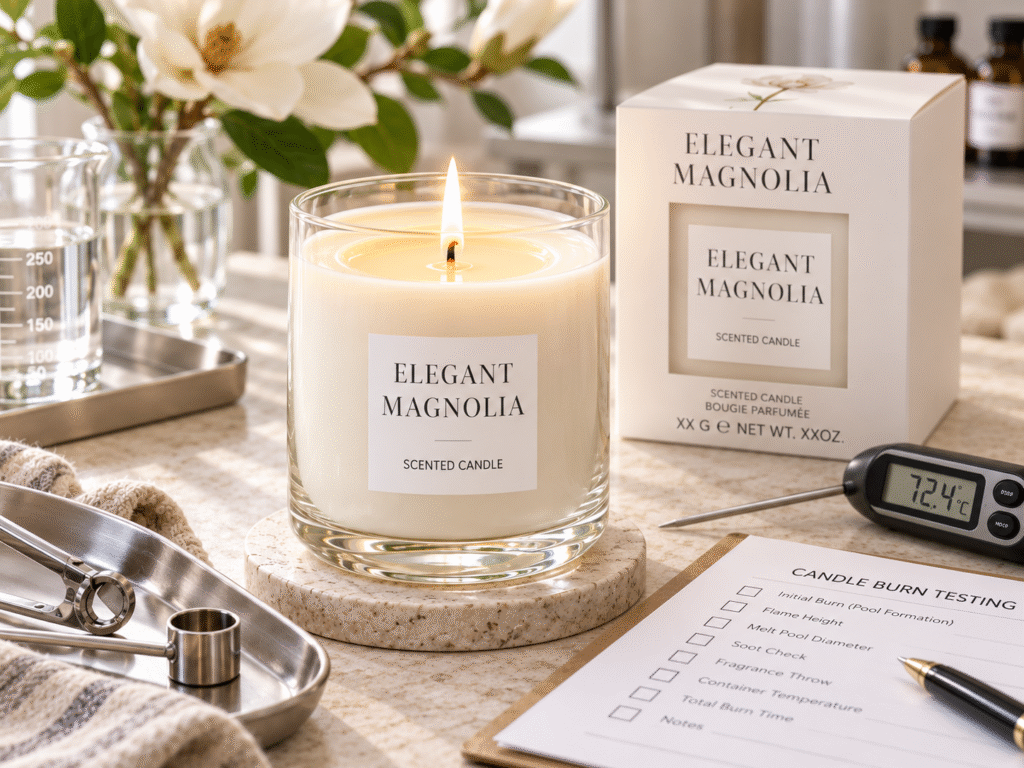
A candle that burns evenly during its first hour is not necessarily ready for mass production.
For candle brands, importers, and wholesale buyers, candle burn testing is about more than checking whether the wick stays lit. It helps identify problems with flame behavior, melt pool development, soot, container safety, and performance throughout the candle’s burning life.
Before approving a custom candle sample, buyers should understand what has been tested, how the results were recorded, and whether the findings apply to the final production specification.
Why Is Candle Burn Testing Important Before Mass Production?
A scented candle is a system of wax, fragrance, wick, and container. Changing one component can affect how the others perform.
Burn testing helps evaluate three areas:
- Safety: Identifying potentially hazardous flame behavior, container problems, and other fire-related risks.
- Performance: Observing wick behavior, melt pool development, and burning consistency.
- Production readiness: Confirming that the approved product design has been tested under defined conditions.
These are related but distinct objectives.
A candle may develop an attractive, even melt pool without satisfying every applicable safety requirement. Likewise, meeting a fire safety standard does not automatically establish that the candle delivers the desired fragrance or burn time.
Buyers should evaluate both compliance-related results and product performance before approving a formula.
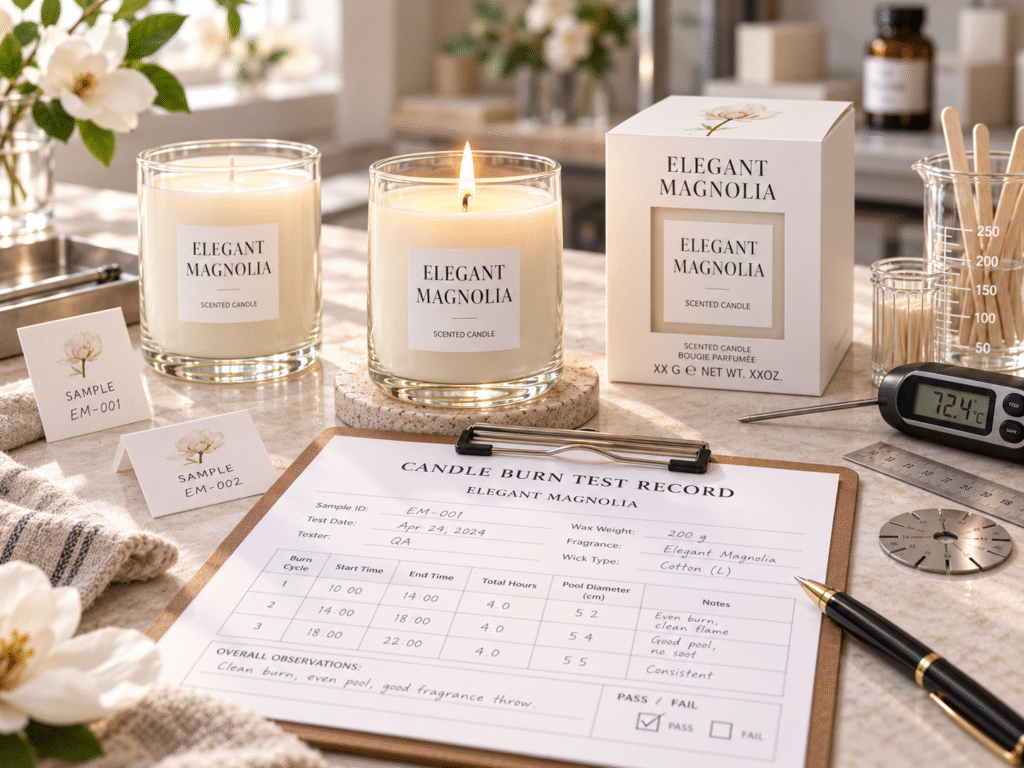
What Should Buyers Check During a Candle Burn Test?
A useful candle burn test examines several characteristics of the finished product.
Flame Behavior
The flame should be evaluated for its height, stability, and unusual changes during burning.
Excessive flame height, persistent instability, or unexpected secondary ignition requires investigation.
The acceptable criteria should follow the applicable test method and product type rather than a single general rule applied to every candle.
Melt Pool Development
The melt pool is the liquid wax surrounding the burning wick.
Its shape, depth, and development provide useful information about how the wick works with the wax and container.
An uneven melt pool may indicate a wick or formulation issue, but buyers should avoid assuming that every candle must achieve a full-width melt pool during its first burn.
Melt pool behavior should be assessed across the candle’s burning life.
Wick Performance
Buyers should check whether the wick remains appropriately positioned and behaves consistently.
Potential problems include excessive carbon buildup, wick leaning, unexpected extinguishing, and changes in flame behavior.
For multi-wick candles, the interaction between individual wicks also needs consideration.
Soot and Smoke
Visible smoking, soot deposits, and unusual carbon buildup should be recorded.
Not every visible emission indicates a failed product, and soot performance may require a separate standardized test.
However, persistent abnormal smoking is a useful warning sign during product development.
Container Safety
For glass jar candles, container integrity is particularly important.
Burn testing should consider cracking, breakage, excessive heating, and other problems that could arise during use.
A container’s appearance alone does not demonstrate that it is suitable for the final candle formula.
Burn Time and End-of-Life Behavior
Burn time should be determined using a documented method, including the definition of the test endpoint.
Buyers should also review what happens near the end of the candle’s usable life.
As the wax level decreases, the relationship between the flame, remaining wax, and container changes. Testing should account for these later burning stages.
Why Should Candles Be Tested Beyond the First Burn?
A candle can behave differently as it is used.
During the initial burn, the wick is relatively long and the wax surface is near the top of the container.
In the middle stages, the melt pool, wick condition, and container temperature patterns may change.
Near the end of the candle’s life, the flame is closer to the bottom of the vessel, and the remaining wax volume is lower.
A product that appears satisfactory after one short test may develop issues later.
For example, a glass jar candle could show stable flame behavior during its first two burns but experience different heating conditions as the wax approaches the bottom.
This is why a short demonstration video should not replace a properly documented burn test covering the stages required by the relevant testing protocol.
Buyers should ask whether the test reached its specified endpoint and whether observations were recorded across the burning cycles.

What Standards Apply to Candle Burn Testing?
The relevant candle safety testing requirements depend on the product type and destination market.
Three important references are:
| Standard | Main Focus |
|---|---|
| ASTM F2417-26 | Fire safety specifications for candles |
| EN 15493:2026 | Fire safety requirements for indoor candles |
| EN 15426:2018 | Sooting behavior of indoor candles |
These standards address different aspects of candle safety and performance. They should not be treated as interchangeable.
For example, sooting behavior and fire safety are separate evaluation areas.
The applicability of a standard also depends on the candle’s design. A single-wick glass jar candle, a three-wick candle, and a decorative freestanding candle may require different testing considerations.
Importers should confirm the current standards, destination-market regulations, product labeling requirements, and scope of testing before placing an order.
An internal factory test can provide valuable development information, but it should not automatically be presented as third-party certification or proof of full regulatory compliance.
What Should a Candle Burn Test Report Include?
A statement such as “the candle burns well” is not enough for production approval.
A useful candle testing report should allow the buyer to identify the sample, understand the testing method, review the observations, and see how the conclusion was reached.
Buyers can use the following checklist:
| Report Item | What to Check |
|---|---|
| Product identification | Model, dimensions, wax weight, and vessel type |
| Formula and wick | Traceable formula reference and wick specification |
| Sample information | Quantity, batch, and sample date |
| Testing method | Applicable method, conditions, and burning cycles |
| Flame observations | Flame behavior and relevant measurements |
| Melt pool and wick | Development, positioning, and abnormal behavior |
| Soot and container | Recorded observations or separate test results |
| Final results | Findings, acceptance criteria, and any corrective actions |
The exact mandatory reporting fields depend on the applicable standard. This checklist is intended to support purchasing and quality review.
Photographs and videos can help explain observations, but they should be linked to identifiable samples and test records.
If a problem was found and corrected, buyers should also request evidence that the revised product was retested as appropriate.
When Should a Candle Be Retested?
An approved test result applies to the product configuration that was evaluated.
If the product changes, the manufacturer should assess whether additional testing is necessary.
Changes that may affect burning performance include:
- Changing wax type or formulation
- Replacing the fragrance or adjusting fragrance load
- Changing wick material, size, position, or quantity
- Modifying container dimensions, geometry, or material
- Changing wax fill weight
- Adding decorative materials that could affect burning
- Making significant changes to relevant production conditions
For example, a single-wick candle that passes testing should not automatically be considered equivalent to a three-wick version in the same container.
Similarly, two candles with identical fragrance concentrations may behave differently when different fragrance oils are used.
Not every minor change necessarily requires a complete new third-party test program. The appropriate verification should be determined through a documented assessment of the change and applicable requirements.
The important point is that buyers should not assume an earlier approval covers every later variation.
How Can Buyers Maintain Burn Performance in Mass Production?
Successful sample testing is only the first step.
For private label candles and wholesale orders, the next challenge is ensuring that mass production follows the approved specification.
Keep an Approved Reference Sample
The approved sample should be linked to a clear specification covering the wax formula, fragrance, wick, container, fill weight, and other relevant details.
This gives purchasing, production, and quality teams a consistent reference.
Control Important Production Variables
Factors such as ingredient identification, wick positioning, fill weight, and key manufacturing conditions should be controlled according to the agreed production requirements.
When several fragrances or candle sizes are produced within the same collection, each relevant configuration should be properly identified.
Verify Production Samples
Appropriate production sampling and quality checks help identify differences between approved development samples and manufactured goods.
Where required by the quality plan, selected production samples may undergo additional burn testing.
Buyers should agree on sampling, inspection responsibilities, acceptance criteria, and how nonconforming results will be handled before production begins.
Candle Burn Testing and Product Development at UN CANDLE
For a candle buyer, the most useful question is not simply, “Has this candle been tested?”
It is, “Was the final product configuration tested appropriately, and can the manufacturer provide the results needed for approval?”
At UN CANDLE, we support OEM and ODM scented candle development, including wax and wick selection, fragrance customization, container options, sampling, and bulk production.
If you are developing a private label candle collection, share your intended product dimensions, fragrance requirements, wick configuration, target market, and order quantity with our team.
These details provide a starting point for discussing sample development, quality requirements, and the testing information needed before mass production.
