
UN CANDLE Buyer Guide
How to Make Scented Candles: A Step-by-Step Guide
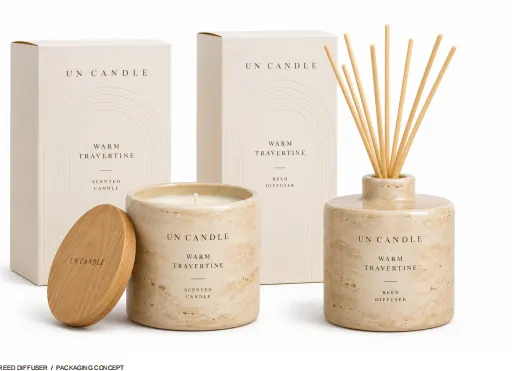
Featured product: UNCANDLE Warm Travertine collection. Product reference photo.
Want to learn how to make scented candles at home? You only need a few basic materials: candle wax, fragrance oil, a wick, and a suitable candle jar.
The process involves melting wax, adding fragrance, pouring the mixture into a prepared container, and allowing it to cool and cure. The key is choosing the right combination of wax, candle fragrance, and wick so your finished candle smells good and burns properly.
This guide explains how to make scented candles step by step, including the ingredients you need, the best scents for candle making, fragrance measurements, and tips for avoiding common mistakes. Whether you are making a DIY candle for your home or learning how to create candles for a future business, the same basic principles apply.
Key Takeaways
- Basic ingredients: Candle wax, fragrance oils, wicks, and heat-resistant containers.
- Wax selection: Choose a wax designed for your intended candle type.
- Fragrance selection: Use oils suitable for candle making and test them with your chosen wax.
- Fragrance load: Measure fragrance oil by weight and follow the wax supplier's maximum limit.
- Making process: Prepare, melt the wax, mix, pour, cool, cure, and test.
- Best results: Check scent throw, wick performance, and the finished candle before making larger batches.
What Do You Need to Make Scented Candles?
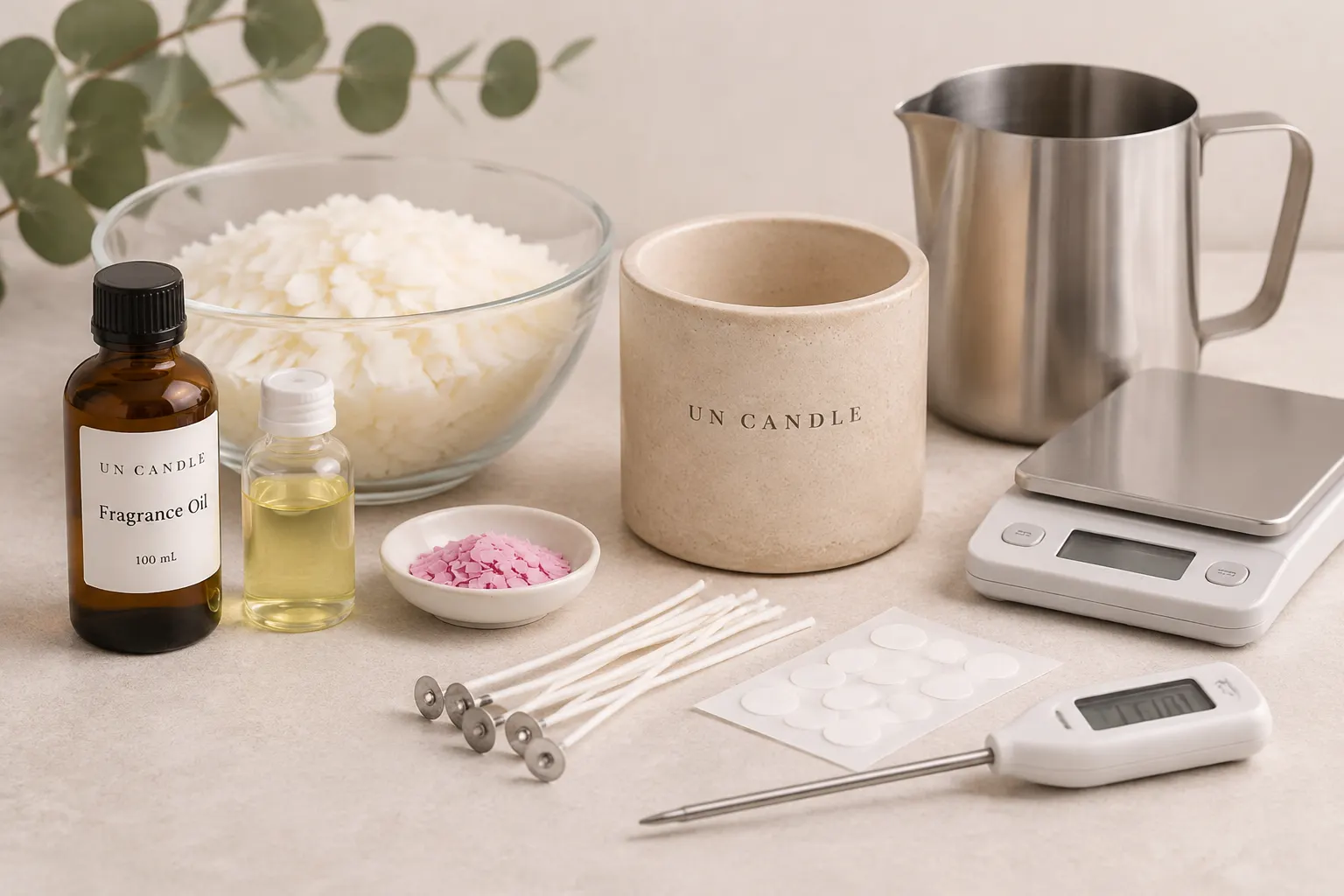
Before starting, prepare your candle making supplies. Having everything ready makes the process easier and helps prevent mistakes.
Ingredients for Scented Candle Making
| Material | Purpose |
|---|---|
| Candle Wax | Provides the main structure and fuel |
| Fragrance Oil | Creates the candle's scent |
| Candle Wick | Draws melted wax toward the flame |
| Candle Container | Holds the wax during cooling and burning |
| Candle Dye | Adds color if desired |
Choose materials specifically intended for candle making. Use fragrance oils made for candles and containers designed to withstand the heat generated during burning.
You can skip the dye if you prefer a natural wax color. If you are comparing supplies online, check the supplier's product page and technical data sheet for the intended application, recommended use, and handling instructions.
What Candle Making Equipment Do You Need?
You will also need:
- A digital scale for measuring wax and fragrance oil
- A thermometer for checking wax temperature
- A double boiler or suitable wax melter
- A heat-resistant pouring pitcher
- A stirring utensil
- Wick stickers and wick holders
- Scissors or a wick trimmer
A scented candle making kit may include some of these items. Check the contents before buying, as some kits contain only wax, wicks, and fragrance oils.
For better results, weigh your ingredients rather than estimating quantities by volume.
Which Wax Is Best for Making Scented Candles?
Choosing the right candle wax is an important part of scented candle making. Different waxes have different melting points, textures, and fragrance performance.
| Wax Type | General Characteristics | Common Applications |
|---|---|---|
| Soy Wax | Plant-based, often has a creamy appearance | Container candles |
| Paraffin Wax | Offers flexibility in fragrance and color development | Container and molded candles |
| Bienenwachs | Has its own natural honey-like scent | Pillar and specialty candles |
| Coconut Wax Blends | Often selected for smooth finishes | Premium container candles |
| Blended Wax | Combines properties of different waxes | Custom candle formulas |
There is no single best wax for every scented candle. Paraffin wax, soy wax, and coconut wax blends each behave differently, so choose according to the candle style and the supplier's guidance.
For beginners, a container wax designed for glass jars is a practical starting point. For commercial candle development, also consider fragrance compatibility, wick performance, surface appearance, and production consistency.
The best wax for scented candles is the one that performs well with the selected fragrance, wick, and container.
What about wax melts? Wax melts are scented wax products designed to release fragrance in a warmer without a candle wick or open flame. They use wax and fragrance too, but their formula and performance requirements are not identical to those of a wicked candle. Do not assume that a candle formula will work unchanged in wax melts.
What Are the Best Scents for Candle Making?
Choosing fragrance is one of the most enjoyable parts of making scented candles.
The best scents for candle making depend on the atmosphere you want to create, your target audience, and the intended season.
| Scent Family | Popular Fragrance Notes | Common Candle Styles |
|---|---|---|
| Floral | Rose, Jasmine, Lavender, Peony | Romantic and elegant |
| Fruity | Strawberry, Peach, Apple, Berry | Fresh and cheerful |
| Zitrusfrüchte | Lemon, Bergamot, Orange, Grapefruit | Hell und erfrischend |
| Woody | Cedarwood, Sandalwood, Vetiver | Warm and natural |
| Gourmand | Vanilla, Caramel, Coffee | Sweet and comforting |
| Fresh | Green Tea, Linen, Eucalyptus | Clean and light |
| Spicy | Cinnamon, Clove, Ginger | Warm and seasonal |
Some combinations worth testing include:
- Lavender and Eucalyptus: A fresh herbal direction.
- Vanilla and Sandalwood: A soft, warm fragrance.
- Lemon and Cedarwood: A balance of bright and woody notes.
- Rose and White Musk: A gentle floral profile.
- Cinnamon and Vanilla: A warm seasonal combination.
These are fragrance development ideas rather than guaranteed finished-candle formulas. Test each blend in the selected wax before deciding on the final scent.
How to Choose Scented Oils for Candle Making?
Not every scented oil works well in candle wax.
When choosing scented oils for candle making, consider three things.
1. Candle Application
Choose fragrance oils that the supplier identifies as suitable for candle making. Do not assume that perfume oils, room fragrance oils, or essential oils are automatically suitable for burning in candles.
2. Wax Compatibility
Different waxes may produce different results with the same fragrance oil. Test the oil with your selected wax instead of judging it only by how it smells in the bottle.
3. Fragrance Performance
Evaluate both cold throw and hot throw. Together, these describe the candle's scent throw: how it smells when unlit and how it releases fragrance while burning.
A fragrance that smells strong in its bottle may not produce the same result in the finished candle. A good candle maker evaluates the fragrance in the complete wax-and-wick system rather than judging the oil alone.
How Much Fragrance Oil Should You Add to Candle Wax?
Fragrance load refers to the amount of fragrance oil used relative to the weight of the wax.
For example, a 6% fragrance load means adding 6 g of fragrance oil for every 100 g of wax.
Use this formula:
Fragrance Oil Weight = Wax Weight × Fragrance Load
| Wax Weight | 6% Fragrance Load | 8% Fragrance Load |
|---|---|---|
| 100 g | 6 g | 8 g |
| 200 g | 12 g | 16 g |
| 300 g | 18 g | 24 g |
| 500 g | 30 g | 40 g |
These are calculation examples, not universal fragrance recommendations.
Always check the maximum fragrance load specified by your wax supplier and follow the fragrance supplier's usage instructions. The melting point of a wax and its recommended fragrance-addition temperature are related to processing, but they are not interchangeable measurements. Follow the technical guidance for the exact wax you use.
Adding more fragrance oil does not automatically make a candle smell stronger. Excess oil may cause sweating, separation, or poor burning performance.
For a new formula, test the finished candle before increasing the fragrance concentration.
How to Make Scented Candles Step by Step
Once your materials are ready, follow these seven steps to make a basic scented container candle.
Step 1: Prepare the Candle Container and Wick
Start with a clean, completely dry, heat-resistant candle jar.
Attach the wick tab to the bottom of the container using a suitable wick sticker. Position the wick in the center and secure its upper end with a wick holder.
The wick should remain upright during pouring and cooling.
Choose a wick based on the wax formulation, container diameter, fragrance load, and intended burning performance. Wick size matters: a wick that is too small may struggle to create a suitable melt pool, while one that is too large may produce an overly large flame, excess heat, or soot. Test the complete candle rather than choosing by jar diameter alone.
Step 2: Measure and Melt the Candle Wax
Weigh the required candle wax using a digital scale.
Place it in a suitable pouring pitcher and melt the wax using a double boiler or purpose-designed wax melter.
Use a thermometer to monitor the temperature. Follow the melting range provided for your chosen wax, since different waxes have different melting points and processing instructions.
Avoid overheating the wax. Never leave melting wax unattended or expose it to direct flame.
Step 3: Add the Fragrance Oil
When the melted wax reaches the recommended fragrance-addition temperature, weigh and add your selected fragrance oil.
Stir gently until the fragrance mixes evenly with the wax.
The correct mixing temperature and time depend on the wax and fragrance combination. Follow the supplier's instructions rather than using one temperature for every candle.
Step 4: Pour the Scented Wax into the Container
Allow the wax to reach the recommended pouring temperature.
Pour slowly into the prepared container while keeping the wick centered.
Avoid moving the container during cooling. Keep the wick upright and prevent drafts or sudden temperature changes that may affect the wax surface.
Step 5: Allow the Candle to Cool and Set
Leave the candle undisturbed on a stable, heat-resistant surface.
As the wax cools, it will become solid around the wick.
Some wax blends may develop small depressions, cracks, or uneven surfaces. If these problems occur, review the wax type, pouring temperature, and cooling conditions.
Step 6: Trim the Wick and Cure the Candle
Once the wax is fully solid, remove the wick holder and trim the wick to the recommended length.
Allow the candle to cure for the period recommended by the wax supplier.
Different waxes need different curing times. Do not assume that every scented candle requires the same conditioning period.
Step 7: Test the Finished Scented Candle
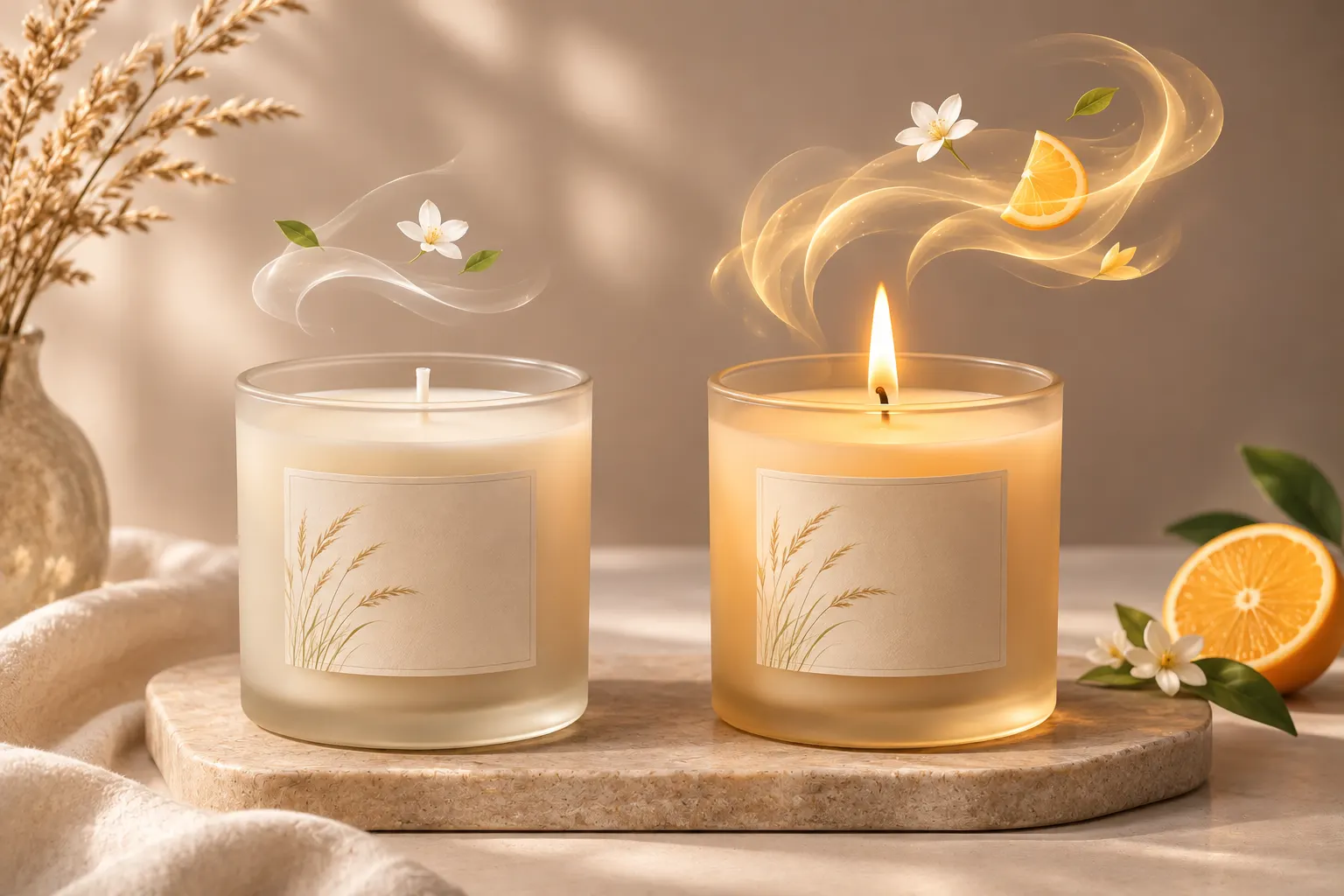
Before making more candles with the same formula, evaluate the finished product.
Check:
- Cold Throw: How the candle smells when unlit.
- Hot Throw: How the fragrance performs while burning.
- Flame Behavior: Whether the flame remains stable.
- Melt Pool: Whether the wax melts evenly across the surface.
- Container Condition: Whether the vessel shows signs of overheating or damage.
- Wax Appearance: Whether oil separation or another visible defect appears.
- Burn Time: How long the candle burns under the specified test conditions.
A candle that smells strong when unlit does not necessarily perform well when burned. The way a candle burns also affects how it releases fragrance, so assess scent throw and burn performance together.
Why Do Homemade Scented Candles Sometimes Turn Out Poorly?
Even when you follow scented candle making instructions, problems may appear.
| Common Problem | Possible Cause | What to Review |
|---|---|---|
| Weak fragrance | Fragrance or wax mismatch | Fragrance choice and mixing process |
| Oil droplets | Excess fragrance or poor mixing | Fragrance load and wax limits |
| Uneven surface | Cooling or pouring conditions | Wax temperature and cooling area |
| Candle tunneling | Wick and burn mismatch | Wick size and container diameter |
| Excessive soot | Wick or combustion issue | Wick selection and burn testing |
| Off-center wick | Poor wick fixing | Wick holder and positioning |
These problems cannot always be solved by changing one ingredient.
For example, adding more scented oil may seem like an easy way to improve scent strength. However, excess fragrance can create other formulation and burning problems.
Change one variable at a time and compare the results using controlled samples.
How Much Does It Cost to Make Scented Candles?
Making scented candles at home can be economical if you already have the equipment and plan to make several candles.
However, the total cost depends on the materials and packaging you choose.
The main expenses include:
- Candle wax
- Fragrance oils
- Wicks and wick stickers
- Candle jars and lids
- Candle dye, if used
- Measuring and melting equipment
- Labels and packaging
A simple way to calculate material cost is:
Cost per Candle = Wax + Fragrance Oil + Wick + Jar + Other Materials
For a small DIY candle batch, divide the total material cost by the number of finished candles to estimate the cost per unit. If you plan to sell homemade scented candles, also consider labor, packaging, failed test batches, shipping, and product testing.
Can You Turn Scented Candle Making Into a Business?
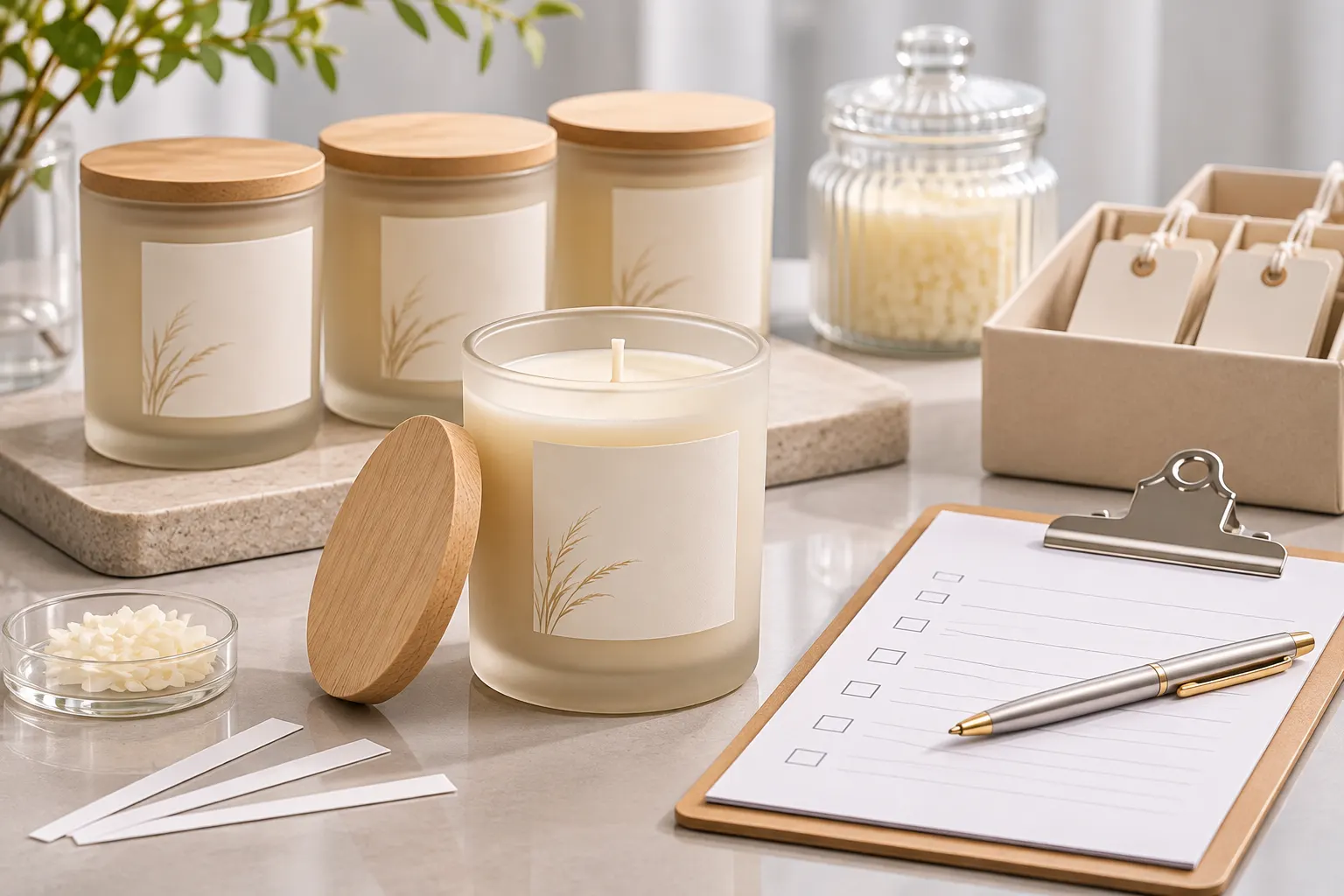
Making one successful DIY candle is different from producing a high quality candle consistently at commercial scale.
For a retail collection, the fragrance, appearance, fill weight, wick performance, and packaging need to remain consistent across production batches.
A candle maker developing a brand should also consider:
- Fragrance families and individual scents
- Wax formulation and fragrance load
- Container shape, size, and finish
- Einwick- oder Mehrwickkonfiguration
- Labels and retail packaging
- Quantity per fragrance
- Target market and delivery requirements
UNCANDLE supports OEM and ODM scented candle development, including fragrance selection, wax and wick options, custom containers, sample development, and private label packaging.
Whether you are developing your first candle collection or expanding an existing range, defining the scent family, vessel design, wax weight, target market, and packaging requirements helps establish a clear product brief.
Planning your own scented candle collection? Contact UNCANDLE to discuss product development and wholesale manufacturing.
Frequently Asked Questions About Scented Candle Making
What ingredients do you need to make scented candles?
The basic ingredients are candle wax, candle-compatible fragrance oil, and a wick. You also need a heat-resistant container for jar candles. Candle dye is optional.
What are the best scents for candle making?
Popular options include vanilla, lavender, rose, sandalwood, citrus, and eucalyptus. The best choice depends on your target fragrance profile and how well the oil performs in the selected wax.
Can you use essential oils for candle making?
Some essential oils work in certain candle formulas, but not all perform well in wax or during burning. Check their intended application and test the finished candle before use.
What wick size should I use for a scented candle?
Wick size depends on the wax, fragrance load, container diameter and shape, and the finished candle's burn performance. Start with the wick supplier's recommendations, then test the complete candle.
Why is my homemade scented candle not smelling strong?
Weak fragrance may result from the fragrance blend, wax, fragrance load, wick, or curing conditions. Check both cold throw and hot throw before changing the formula.
How long should scented candles cure?
Curing time depends on the wax and formula. Follow the wax supplier's instructions and test the finished candle to evaluate its fragrance performance.
Are wax melts made the same way as scented candles?
Both use wax and fragrance, but wax melts do not use a wick. Their formula and performance should be developed for use in a warmer rather than copied directly from a container candle formula.
Final Thoughts
Learning how to make scented candles starts with choosing suitable materials, measuring fragrance carefully, and following the right melting, pouring, and curing instructions.
Start with a small batch and keep notes on your wax, fragrance load, wick size, and test results. Once you understand how these parts work together, you can explore new scents, wax blends, and container designs.
For brands moving beyond candles at home, consistent formulas and finished-product testing become essential. UNCANDLE can support the next stage through OEM and ODM scented candle development.