
UNCANDLE Buyer Guide
Where to Buy Scented Oils for Candles?
Looking for where to buy scented oils for candles? You can find candle fragrance oils from candle-making supply stores, online fragrance suppliers, wholesale distributors, and fragrance houses.
The best supplier depends on how much you need, which scents you want, and whether you make candles at home or run a candle business.
For beginners, small samples make it easier to test different scent oils. For candle brands and manufacturers, high quality fragrance oils, clear product information, consistent supply, and competitive wholesale prices matter just as much as fragrance selection.
This guide explains where to buy fragrance oils for candles, how to compare suppliers, and what to check before placing a bulk order.
Where Can You Buy Scented Oils for Candles?
There are four common places to buy scented oils for candle making.
| Supplier Type | Best For | Main Advantage |
|---|---|---|
| Candle Making Supply Stores | DIY beginners | Small bottles and basic candle making supplies |
| Online Fragrance Suppliers | Small candle brands | Wide selection of candle fragrances |
| Wholesale Fragrance Suppliers | Growing businesses | Bulk sizes and wholesale prices |
| Fragrance Houses | Established brands | Custom fragrance development |
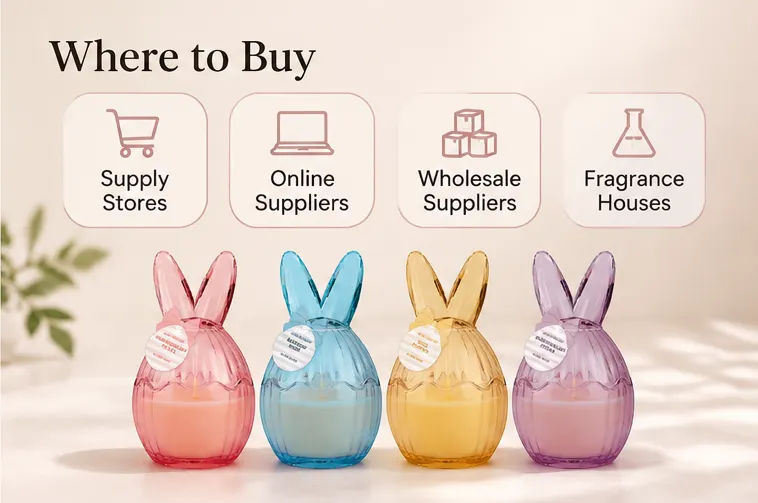
1. Candle Making Supply Stores
Candle making supply stores are a good starting point if you make candles at home.
They usually sell fragrance oils alongside candle wax, wicks, jars, and other candle making supplies.
Many offer small bottles, so you can test several scents without buying large quantities.
Some suppliers also sell ingredients for candles and soaps, which is useful if you make different scented products.
2. Online Fragrance Oil Suppliers
Online fragrance suppliers offer a wide range of oils for candles.
You can browse by scent family, fragrance notes, or intended application. Their product pages may also provide information about scent strength, recommended fragrance loads, and product specifications.
Before ordering, check the intended use. Fragrance oils are designed for different applications, and an oil made for perfume, soap, or room spray is not automatically suitable for candles.
3. Wholesale Fragrance Oil Suppliers
If you make candles regularly, wholesale fragrance oil suppliers may offer better purchasing options.
They often sell larger bottles, bulk containers, and volume-based pricing. Some also offer premium fragrance oils for brands looking for more distinctive scents.
Before placing an order, compare:
- Minimum order quantity (MOQ)
- Price per kilogram
- Wholesale prices and volume discounts
- Shipping costs
- Delivery time
- Sample availability
- Repeat-order availability
A low price per kilogram does not always mean a lower total purchasing cost. Include shipping, storage, and testing when comparing suppliers.
4. Fragrance Houses
Fragrance houses are worth considering if you want to develop a signature scent for your candle brand.
They may support custom fragrance development based on your preferred scent profile and product requirements. This option is more suitable for established brands and commercial product development than for occasional DIY projects.
Which Fragrance Oil Suppliers Should You Consider?
If you are looking for where to buy fragrance oils for candles in the United States, these suppliers are worth exploring.
| Supplier | Main Offer | Suitable For |
|---|---|---|
| CandleScience | Fragrance oils, samples, and larger sizes | Beginners and growing brands |
| Lone Star Candle Supply | Candle fragrance oils and sample options | DIY makers and wholesale buyers |
| Bramble Berry | Fragrance oils and candle-making supplies | Small businesses |
| Bulk Apothecary | Fragrance oils in different quantities | Individual and bulk buyers |
| Wholesale Supplies Plus | Fragrances for candles and other products | Multi-product makers |
CandleScience
Shop CandleScience Fragrance Oils
CandleScience offers a wide selection of candle fragrance oils. Buyers can compare fragrance descriptions and available sizes before ordering.
Its range is useful for testing scents before moving to larger quantities.
Lone Star Candle Supply
Lone Star offers fragrance oils for candle making in different sizes. Its sample and larger purchasing options can help buyers compare fragrances before choosing scents for regular production.
Bramble Berry
Shop Bramble Berry Fragrance Oils
Bramble Berry offers fragrance oils and supplies for candle making and other applications. Its product pages provide fragrance descriptions and product information. Smaller purchasing options help buyers test scents before ordering larger bottles.
Bulk Apothecary
Shop Bulk Apothecary Candle Fragrance Oils
Bulk Apothecary offers a broad selection of fragrance oils in different quantities. It is worth comparing if you need fragrance materials alongside other candle-making supplies.
Wholesale Supplies Plus
Shop Wholesale Supplies Plus Candle Fragrances
Wholesale Supplies Plus offers fragrance oils and other materials for candles, soaps, and personal care products. It can be useful for businesses that produce several types of scented products.
These suppliers are examples for the US market, not a ranking or endorsement. Check current prices, product availability, shipping terms, and documentation before ordering.
What Should You Check Before Buying High Quality Fragrance Oils?
Not every fragrance oil works well in candle wax. Before choosing a supplier, check these details.
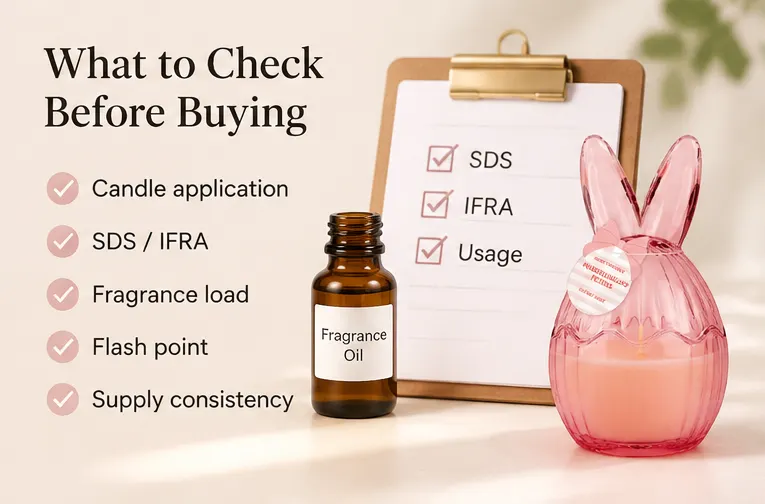
| Qué comprobar | Why It Matters |
|---|---|
| Candle Application | Confirms the intended use |
| Fragrance Description | Helps you understand the scent profile |
| SDS | Provides safety and handling information |
| IFRA Documentation | Shows applicable fragrance-use guidance |
| Fragrance Load | Helps determine suitable formulation levels |
| Flash Point | Provides information relevant to handling and transport |
| Sample Availability | Allows testing before bulk purchasing |
| Supply Consistency | Supports repeat production |
Two documents are particularly useful.
SDS (Safety Data Sheet)
An SDS explains a material's hazards, handling, storage, and transportation requirements.
IFRA Certificate of Conformity
Ask the fragrance supplier for applicable IFRA documentation for the intended application.
IFRA publishes standards for fragrance ingredient use. However, it does not issue certificates for individual fragrance products. The fragrance mixture supplier prepares the Certificate of Conformity for the intended use.
An IFRA document does not replace a complete product safety assessment.
You can read more in the official IFRA Standards guidance.
Are Fragrance Oils and Essential Oils the Same?
No. Fragrance oils and essential oils are different materials.
| Type | Main Characteristics | Buying Consideration |
|---|---|---|
| Candle Fragrance Oils | Fragrance blends for candle applications | Check candle-use information |
| Essential Oils | Aromatic materials from botanical sources | Check suitability for the formula |
| Perfume Oils | May be designed for personal fragrance | Do not assume candle suitability |
| Reed Diffuser Oils | Designed for diffuser applications | Not automatically suitable for candles |
Some essential oils can work in certain candle formulas, but not all perform well in wax or during burning.
For beginners, fragrance oils specifically intended for candle making are a practical starting point.
What Affects Candle Fragrance Performance?
Buying a fragrance oil with a strong scent does not guarantee that the finished candle will have strong scent throw.
Several factors affect how a candle releases fragrance.
1. Fragrance Load
Fragrance load refers to the amount of fragrance oil used compared with the weight of the wax.
Adding more oil does not always improve scent strength. Too much fragrance may affect the wax or the way the candle burns.
Always follow the wax supplier's recommended limits. When comparing different fragrance loads, keep clear records of the formula and test results.
2. Wax Type
Different candle waxes can produce different results with the same fragrance.
For example, soy wax, paraffin wax, and coconut wax blends may differ in how they hold and release fragrance.
A fragrance that performs well in soy wax may need further testing in another wax type.
Choose fragrance oils based on the complete candle formula, not just the scent in the bottle.
3. Cold Throw and Hot Throw
- Cold Throw: The scent released when the candle is unlit.
- Hot Throw: The fragrance released while the candle burns.
A fragrance may smell strong in the bottle but produce a different result in melted wax.
Test the finished candle to check both cold throw and hot throw.
4. Flash Point
Flash point is the temperature at which a liquid produces enough vapor to ignite when exposed to an ignition source under a specified test method.
It is useful for understanding fragrance oil handling and safety information. However, flash point is not the recommended temperature for adding fragrance oil to melted wax.
Follow the wax and fragrance suppliers' processing instructions.
For more information, read ¿Más aceite de fragancia hace un recipiente más fuerte?.
Should You Buy Small Samples or Wholesale Fragrance Oils?
The right purchasing quantity depends on your production needs.
| Buying Option | Advantages | Best For |
|---|---|---|
| Small Bottles | Lower initial cost and easier testing | Beginners |
| Medium Bottles | More material for repeat batches | Small candle businesses |
| Bulk Containers | Suitable for larger production | Established brands |
A good rule is to test small before buying in bulk.
A fragrance may smell excellent in the bottle but perform differently after mixing with melted wax.
If you are developing a candle collection, test several fragrances first. Once you approve a scent, compare wholesale prices, MOQ, delivery time, and repeat-order conditions.
For larger orders, ask whether the supplier can maintain the same fragrance specification across future batches.
How Do You Test Candle Fragrance Oils Before Buying in Bulk?
Testing helps you avoid buying large quantities of a fragrance that does not work well in your candle formula.
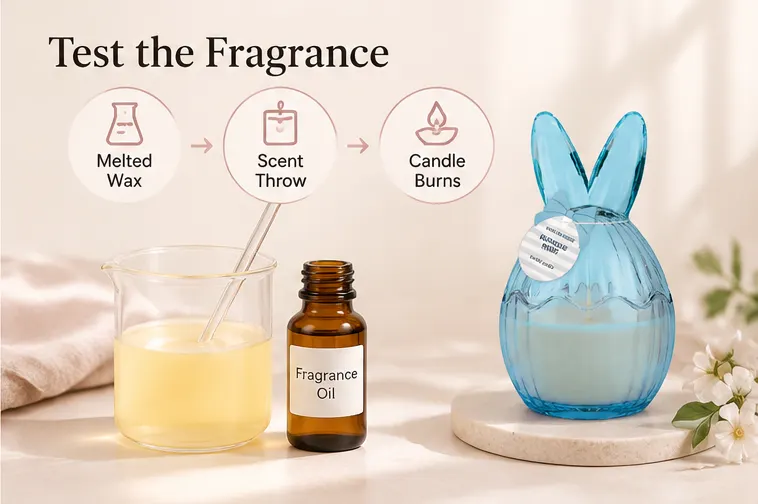
Follow these steps:
- Smell the fragrance: Record its main notes and overall character.
- Check wax compatibility: Test it with your selected wax.
- Review fragrance load: Follow the wax and fragrance suppliers' usage limits.
- Make test candles: Use the intended container and wick.
- Check cold throw: Evaluate the scent when the candle is unlit.
- Check hot throw: Evaluate the fragrance while the candle burns.
- Record the results: Keep the fragrance name, batch reference, formula, and observations.
Do not judge a fragrance only by its smell in the bottle. The wax, wick, fragrance load, and container all affect the finished candle.
If you also make wax melts, remember that their formulas and performance requirements may differ from those of wicked candles. Do not assume that the same fragrance formula will produce identical results in both products.
Can UNCANDLE Help You Choose Custom Fragrances?
Yes. UNCANDLE supports fragrance selection and custom scent development as part of its OEM and ODM scented candle services.
This is useful if you want to create a private label candle collection rather than simply buy fragrance oils for DIY projects.
Commercial candle development may include:
- Selecting the fragrance direction
- Reviewing suitable fragrance materials
- Choosing the wax formulation
- Evaluating fragrance loads
- Selecting the wick and container
- Preparing test samples
- Checking cold throw and hot throw
- Approving the finished candle before mass production
Instead of purchasing fragrance oils separately and hoping they work with your wax, you can evaluate the fragrance and finished candle together during product development.
Whether you are developing a new scented candle collection or expanding an existing range, UNCANDLE can support your OEM and ODM project.
Contact UNCANDLE to discuss your candle collection.
Fragrance Oils FAQs
Where can I buy scented oils for candle making?
You can buy scented oils from candle-making supply stores, online fragrance suppliers, wholesale distributors, and fragrance houses. Choose a supplier that provides clear information about candle applications.
Where can I buy fragrance oils for candles in bulk?
Several suppliers offer larger bottles and bulk containers. Compare MOQ, wholesale prices, shipping costs, and repeat-order availability before purchasing.
Can I use essential oils instead of fragrance oils?
Some essential oils work in certain candle formulas, but not all perform well in wax. Check the supplier's guidance and test the finished candle.
How do I know if fragrance oils are designed for candle making?
Check the product page, intended application, usage guidance, and relevant supplier documents. Then test the fragrance in your selected wax.
What makes high quality fragrance oils suitable for candles?
Look for clear application guidance, consistent product information, relevant safety documents, and reliable supply. Then test the oil in the finished candle to check scent throw and burn performance.
Should I test fragrance oils before buying large quantities?
Yes. Small-scale testing helps you compare scent performance and avoid committing to a large order before approving the fragrance.
Can a candle manufacturer develop a custom fragrance?
Some manufacturers support fragrance selection and custom scent development as part of their OEM and ODM services. Ask about sample development, fragrance approval, and finished-candle testing.
Final Thoughts
Finding the right scented oils for candles is about more than choosing a fragrance you like.
A good supplier should offer candle-suitable fragrance oils, clear product information, reliable supply, and purchasing options that match your needs.
For DIY candle makers, small bottles are useful for exploring new scents. For candle brands and wholesale buyers, sample approval, technical documents, consistent fragrance loads, and reliable supply matter more.
If you are developing a private label candle collection, UNCANDLE can support fragrance selection, sample development, and OEM/ODM manufacturing.