
UN CANDLE-kopersgids
How Do You Choose the Right Candle Scent?
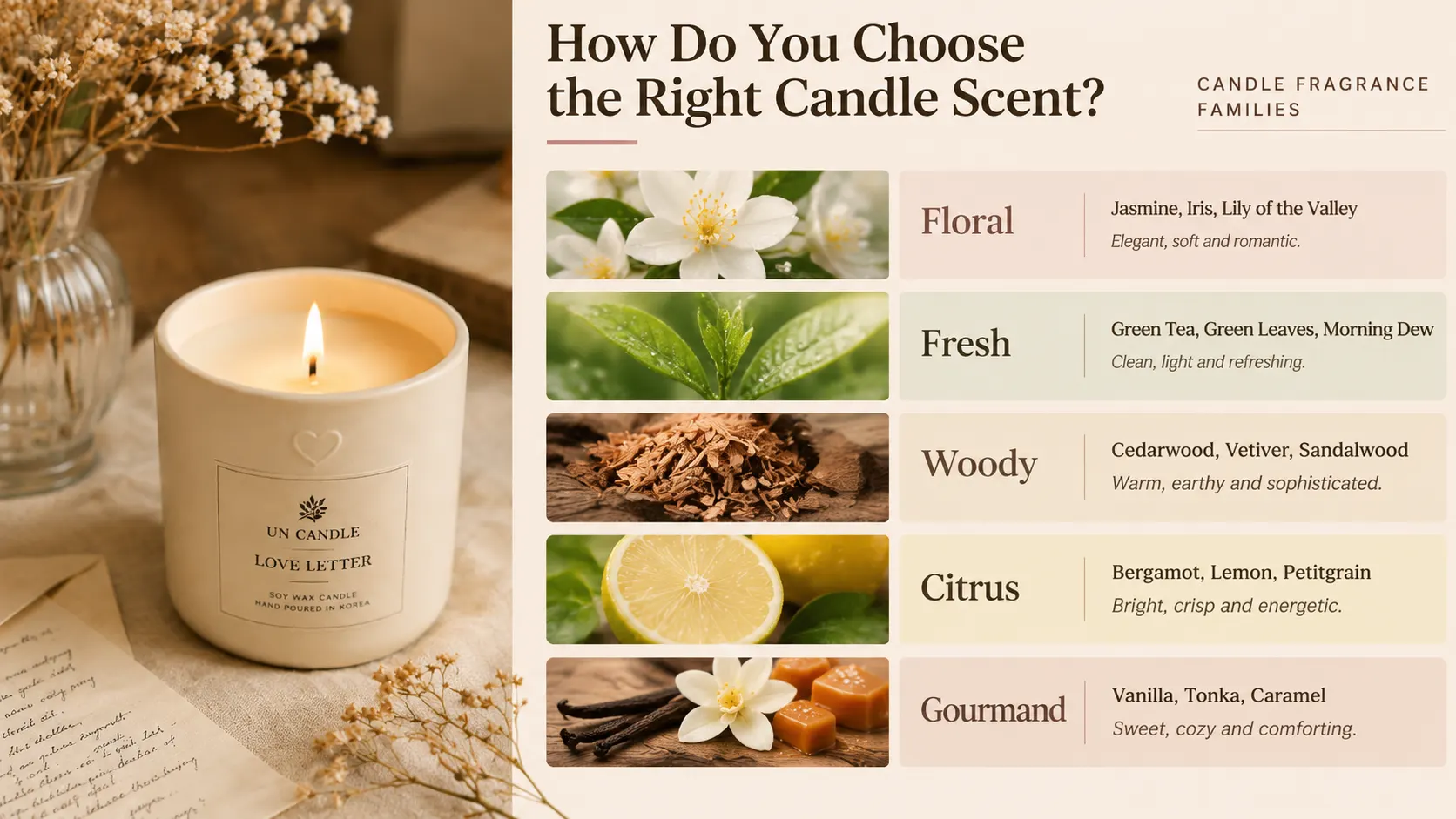
Choosing the right candle scent involves more than finding a fragrance you like. The right choice depends on the fragrance character, intended environment, target customers and the overall identity of the candle collection.
For candle brands and retailers, fragrance selection is also a product development decision. A well-planned collection should offer variety without making individual scents feel unrelated. The fragrance must also perform as expected once combined with the selected wax, wick and container.
Snel antwoord: Begin with a fragrance family that suits your intended customer and brand. Compare top, middle and base-note descriptions, then test your preferred fragrances in finished candle samples for cold throw, hot throw, wax compatibility and consistent burning.
Which Candle Fragrance Families Should You Know?
Before selecting individual fragrance oils, identify the overall scent direction you want to achieve. Most candle fragrances can be grouped into broad families, each with a recognizable character.
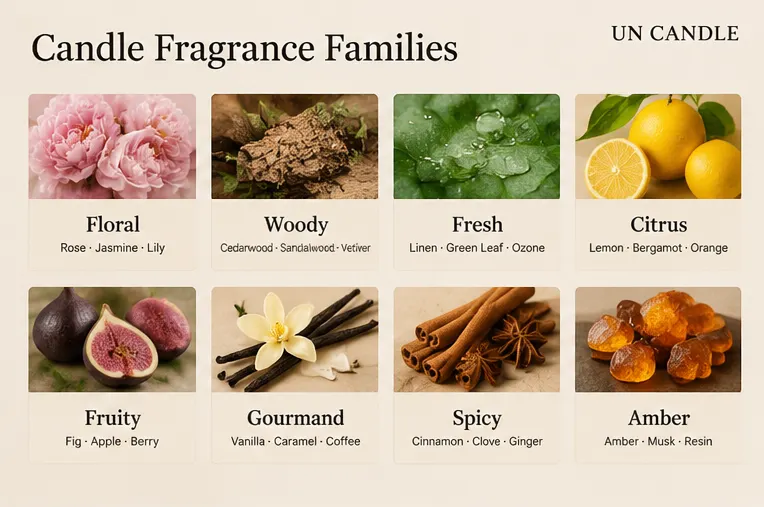
| Geurfamilie | Common Notes | General Character |
|---|---|---|
| Floral | Rose, jasmine, lavender, gardenia | Soft, elegant, romantic |
| Woody | Cedarwood, sandalwood, vetiver | Warm, earthy, sophisticated |
| Fresh | Linen, green leaves, aquatic accords | Clean, light, refreshing |
| Citrus | Bergamot, lemon, orange, grapefruit | Bright, crisp, energetic |
| Fruity | Apple, peach, berry, fig | Juicy, sweet, vibrant |
| Gourmand | Vanilla, caramel, coffee, chocolate | Sweet, creamy, comforting |
| Spicy | Cinnamon, clove, ginger, cardamom | Warm, rich, distinctive |
| Amber | Amber accords, musk, resin, incense | Deep, warm, enveloping |
Fragrances often combine several families. A bergamot, cedarwood and amber blend might open with freshness while retaining a warm woody character.
Buyer takeaway: Select a scent family first, then narrow the brief using individual notes and fragrance references. This creates a clearer basis for comparing samples.
What Are Top, Middle and Base Notes in Candle Fragrances?
Fragrance descriptions often refer to top, middle (heart) and base notes. These terms help communicate a scent concept precisely when working with a fragrance supplier or candle manufacturer.
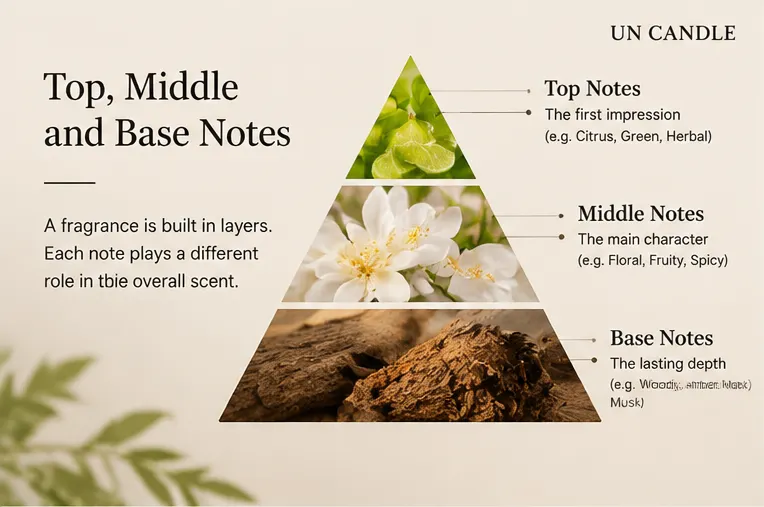
- Top notes: The initial impression of a fragrance, such as bergamot, lemon or light herbal notes.
- Middle notes: The central character, often including floral, fruity, tea or spicy notes.
- Base notes: Notes that add depth, such as cedarwood, vanilla, musk or amber accords.
For example, a proposed scent brief could use bergamot and lemon at the top, jasmine and white tea in the middle, and cedarwood and musk at the base. These are descriptive components, not a promise that a burning candle releases each layer in a fixed sequence. The perceived scent depends on the fragrance formula and how it behaves in the finished candle.
How Do You Choose Candle Scents for Your Target Market?
A candle scent should reflect the product's target customers, sales channel and brand positioning. These are practical design inputs, not reliable shortcuts for predicting the popularity of one fragrance in an entire country.
A brand seeking an understated everyday range might sample green, fresh or light woody directions. A premium gift concept might test layered florals, amber accords or restrained gourmand blends. Supermarkets may value broadly recognizable scent descriptions, while specialist home décor collections can explore more distinctive combinations.
Rather than claiming one fragrance is universally best for the US or Europe, document the target customer, intended shelf position, fragrance preferences and available sales evidence. Use these details to decide which samples are worth developing.
How Can You Build a Balanced Candle Fragrance Collection?
A multi-SKU collection needs clear differences between scents without losing its brand identity. Four candles with nearly identical vanilla profiles may not give shoppers a meaningful choice.
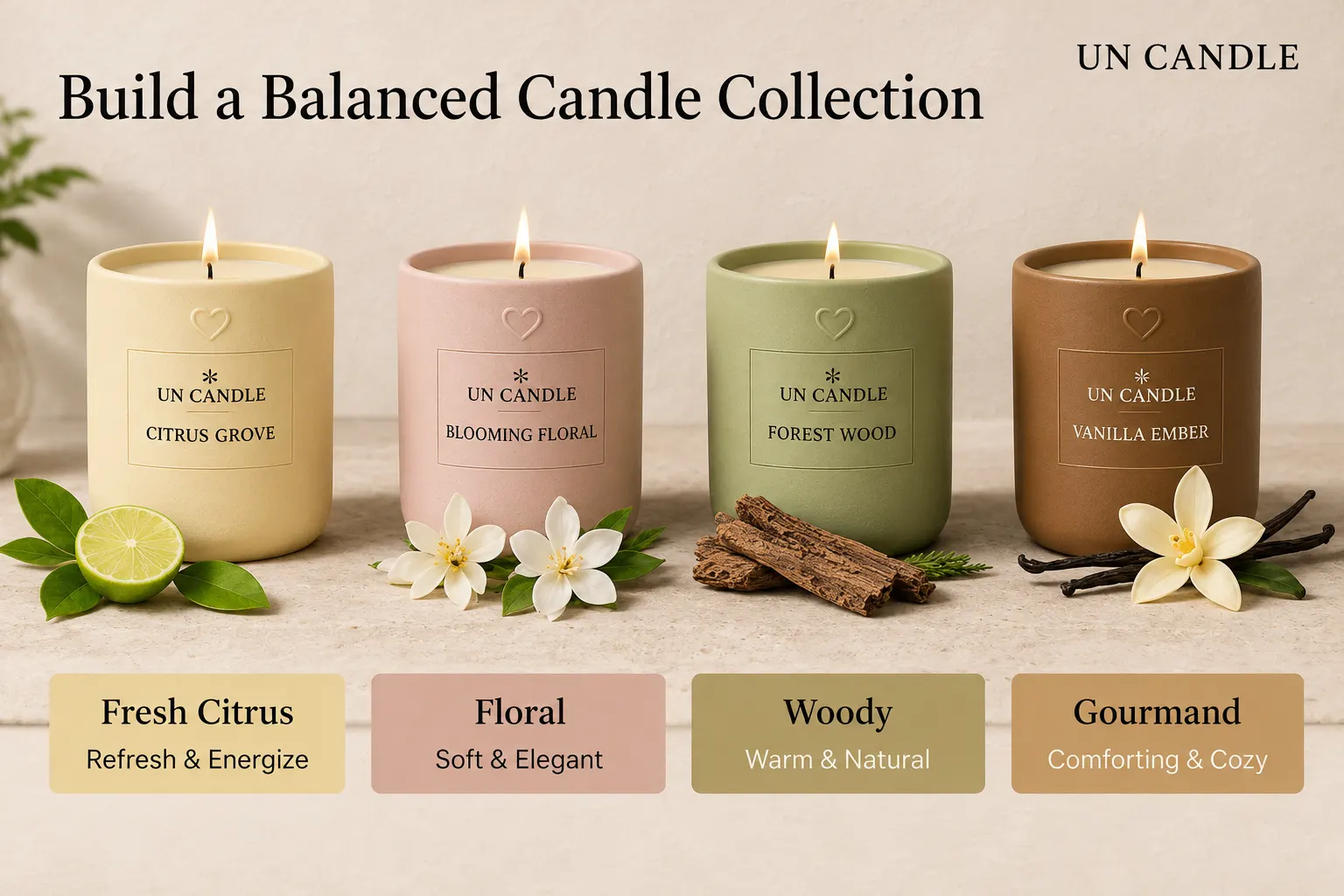
An illustrative four-scent assortment could be:
| SKU | Fragrance Direction | Product Role |
|---|---|---|
| A | Fresh Citrus | Everyday, refreshing |
| B | Soft Floral | Core collection, elegant |
| C | Woody Amber | Premium, warm |
| D | Vanilla Gourmand | Seasonal or gift-oriented |
This assortment is a planning example, not UN CANDLE sales or consumer-preference data.
Buyers can coordinate vessels, lids, label layouts and retail boxes across fragrance variations. A consistent physical design makes the range recognizable, while distinct scent families give each SKU a purpose. Seasonal additions can be considered after the core range is defined.
Verwante lezing: Hoe een Groothandel Kaarsencollectie te plannen.
Does Wax Type Affect Candle Fragrance Performance?
Yes. A fragrance that smells attractive directly from its bottle may perform differently after it is incorporated into wax. Wax composition, fragrance characteristics, wick selection, container geometry and processing conditions all contribute to the finished experience.
Cold throw is the scent perceived from an unlit candle; hete worp is the scent perceived while it burns. Both should be assessed when evaluating a retail fragrance. Neither is accurately predicted from the fragrance oil bottle alone.
A change of fragrance formula may also require renewed wick or burn testing. For further explanation of concentration and performance, see Maakt More Fragrance Oil een Sterkere Kaars?.
How Should Buyers Evaluate Candle Fragrance Samples?
Before approving a fragrance for mass production, evaluate it in a candle using the intended wax, vessel and wick configuration. Compare samples under consistent conditioning and evaluation conditions.
| Evaluation Item | What Buyers Should Check |
|---|---|
| Fragrance identity | Does it match the agreed scent direction? |
| Cold throw | Is the fragrance noticeable and appropriate when unlit? |
| Hot throw | Does it perform as intended during burning? |
| Fragrance balance | Are the notes harmonious and distinguishable? |
| Wascompatibiliteit | Is there visible oil separation or an abnormal wax surface? |
| Burning performance | Is the flame and melt pool behavior acceptable under the test plan? |
| Batch consistency | Do repeated samples retain the agreed fragrance character? |
Approve a traceable final sample and keep the fragrance identifier, formula version, wax and wick specifications, vessel, evaluation notes and artwork version together. A fragrance blotter strip or fragrance oil vial is useful for initial screening, but it cannot substitute for testing a finished scented candle.
How Can You Develop Custom Candle Fragrances With UN CANDLE?
A useful fragrance brief gives the manufacturer more than a vague instruction such as “make it luxurious.” Share preferred fragrance families, examples of note combinations, target customers, market, vessel and size, planned number of SKUs, packaging concept and estimated quantities.
UN CANDLE supports OEM and ODM candle development, including fragrance selection, wax and wick options, vessel customization, sample development and private-label packaging. Discuss your preferred scent direction and product specifications with the team to define appropriate sample-development steps.
For wider supplier-development considerations, see Hoe een Private Label Kaars Fabrikant kiezen.