
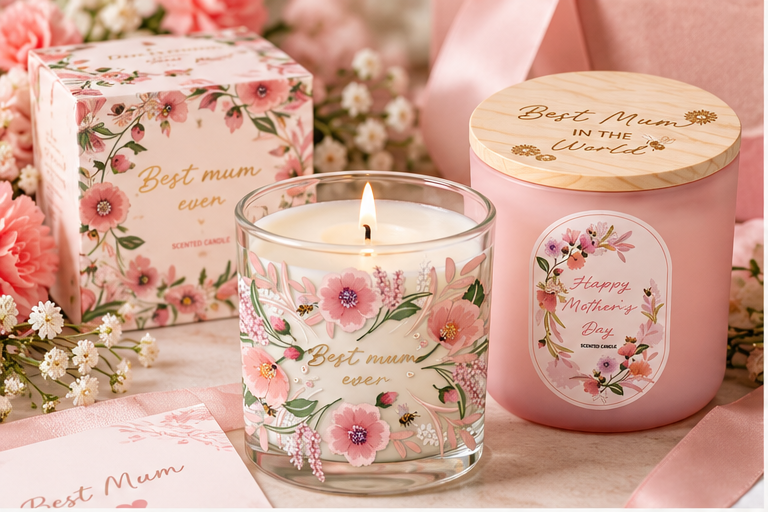
Adding more fragrance oil does not automatically make a scented candle smell stronger when it burns. The finished result depends on how the fragrance, wax, wick, and container work together.
For buyers comparing custom candle samples, asking about fragrance concentration is useful. But a higher percentage alone does not guarantee better scent performance.
The more important question is: Does the finished candle deliver the fragrance experience your customers expect?
What Does Fragrance Load Actually Tell You?
Fragrance load describes how much fragrance oil is added to a candle formula.
Before comparing percentages from different manufacturers, check how each supplier calculates the figure. Some express fragrance load as a percentage of wax weight, while others use the total finished mixture.
For example, adding 8 grams of fragrance oil to 100 grams of wax gives an 8% fragrance-to-wax ratio, but fragrance accounts for approximately 7.4% of the combined mixture.
These figures describe the same formula using different calculations.
For private label scented candles, it is important to establish a consistent calculation method when comparing quotations, specifications, and samples.
Fragrance load is only one part of the formula. Two candles with the same fragrance percentage can perform differently because of their wax composition, fragrance characteristics, wick selection, and container dimensions.
A higher percentage does not necessarily mean a better candle.
Why More Fragrance Oil Doesn’t Always Mean Stronger Scent
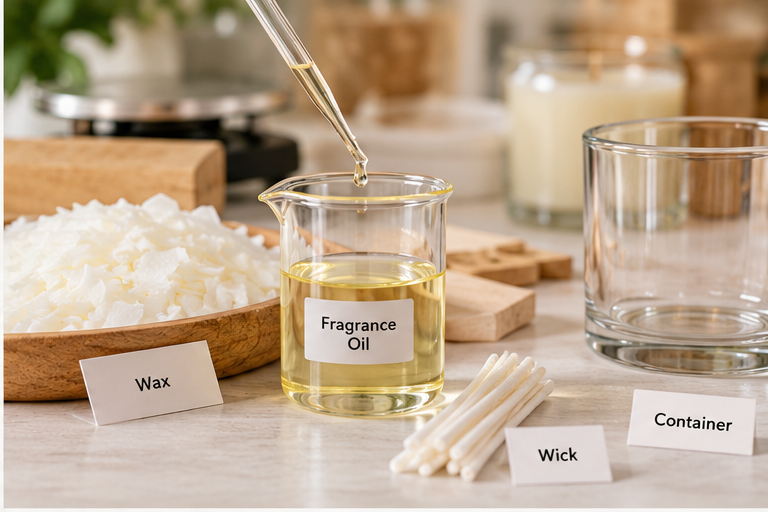
Wax Compatibility
Different waxes and wax blends have different capacities to incorporate fragrance oils.
A wax may perform well with one fragrance at a certain concentration but behave differently with another fragrance at the same percentage.
Adding too much fragrance can affect the consistency of the finished candle. Depending on the formula and storage conditions, buyers may notice oil separation, surface changes, or inconsistent burning.
The objective is to find a fragrance load that works with the selected wax, rather than simply approaching the highest possible percentage.
Fragrance Composition
Not all candle fragrance oils perform the same way.
Some fragrances have a noticeable scent even at relatively low concentrations. Others require further development to achieve the desired effect.
Fragrance composition also influences how the scent changes during burning. The balance of volatile components, fragrance character, and compatibility with the candle system can affect the result.
For instance, increasing the concentration of a fragrance does not guarantee that its individual notes will become proportionally stronger.
When developing a custom candle fragrance, it may be more effective to adjust the fragrance composition than to increase its concentration.
Wick Selection and Melt Pool
The wick plays an important role in fragrance performance.
A candle needs an appropriate balance between wax consumption, flame characteristics, and melt pool development.
If the wick is poorly matched to the wax, fragrance, and container, the candle may not develop the intended melt pool or burn consistently.
Changing the fragrance load can also change burning behavior, meaning that a previously approved wick may need to be tested again.
This is why fragrance performance should be evaluated in the finished candle, not just in a fragrance-and-wax mixture.
Manufacturing and Conditioning
Processing conditions can influence how consistently fragrance is incorporated into the wax.
Mixing procedures, temperature control, cooling conditions, and the time allowed before testing should be considered during sample development.
If two samples are produced or conditioned differently, it becomes harder to determine whether a difference in scent performance comes from fragrance concentration or another variable.
For meaningful comparisons, manufacturers should use consistent preparation and testing conditions.
Cold Throw vs Hot Throw: Which Matters More?
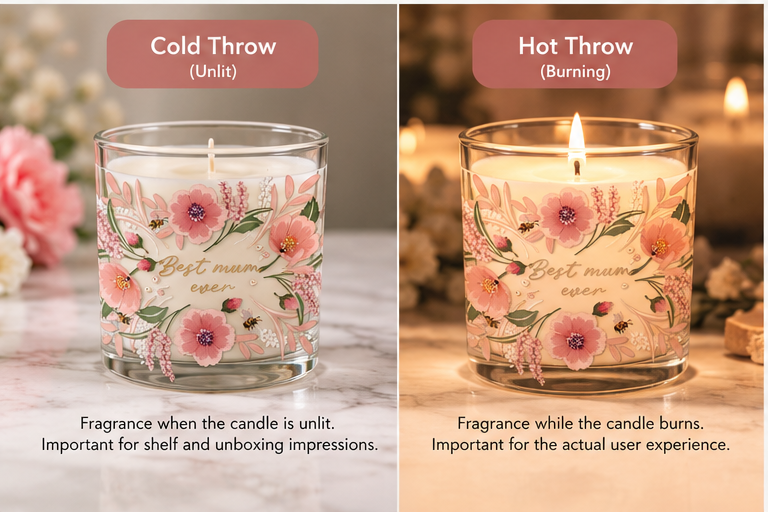
A scented candle has two distinct fragrance experiences: cold throw and hot throw.
Cold throw refers to the scent released when a candle is unlit. It influences the impression customers receive when smelling a candle in a shop or opening its packaging.
Hot throw refers to the fragrance experienced while the candle is burning.
For retail brands, both matter, but they serve different purposes.
| Cold Throw | Hot Throw |
|---|---|
| Evaluated when the candle is unlit | Evaluated while the candle burns |
| Important for shelf and unboxing impressions | Important for the actual user experience |
| Helps customers assess fragrance before purchase | Influences perceived fragrance performance during use |
A candle may smell strong when unlit but provide a weaker fragrance experience during burning.
The opposite can also occur: a candle with moderate cold throw may perform well once its melt pool develops.
For buyers developing custom scented candles, evaluating only the unlit sample is not enough.
Hot throw should be assessed in a consistent environment, using an appropriate room size, burn duration, and evaluation method.
The target is not always the strongest possible fragrance. A candle designed for a small bedroom may require a different scent profile and perceived intensity from one intended for a large living area.
What Happens When a Candle Contains Too Much Fragrance Oil?
Increasing fragrance concentration beyond what a formula can accommodate may introduce problems without improving scent performance.
Potential issues include:
- Oil sweating or separation: Fragrance may appear on the candle surface or separate from the wax.
- Inconsistent burning: Changes in the formula may affect how the candle burns.
- Wick performance problems: Flame behavior, carbon buildup, or soot may change.
- Appearance changes: The finished wax surface may become less consistent.
- Storage instability: Some problems may become visible after temperature changes or extended storage.
However, these symptoms do not automatically prove that too much fragrance oil was used.
For example, surface oiling can also be associated with temperature fluctuations or compatibility problems. Poor burning may involve wick selection, container dimensions, or other formulation variables.
Rather than assuming the fragrance percentage is responsible, buyers should ask the manufacturer to investigate the complete candle system.
A formula change should be followed by appropriate stability and burn testing before mass production.
How Should Buyers Compare Candle Fragrance Samples?
When a candle does not provide the desired scent throw, increasing fragrance load can be one testing option. It should not be the only option.
A practical development process begins with controlled sample comparisons.
Imagine a brand developing a glass jar candle. The manufacturer prepares three samples with different fragrance loads, provided each concentration is suitable for the selected wax and fragrance.
| Sample | Fragrance Load | Testing Focus |
|---|---|---|
| A | 6% | Baseline performance |
| B | 8% | Changes in scent and burning |
| C | 10% | Additional fragrance benefit and compatibility |
These percentages are illustrative test values, not recommended universal fragrance loads.
Initially, the samples should use the same wax, fragrance, container, and wick, with consistent production and conditioning methods. This helps isolate the effect of changing fragrance concentration.
The samples can then be compared for cold throw, hot throw, visual stability, melt pool development, and burning behavior.
Testing should also consider fragrance performance at different stages of the candle’s life, not just during its first burn.
If one concentration performs better, that does not automatically mean the formula is ready for production. The manufacturer may still need to refine wick selection and complete burn and stability testing.
The preferred formula is the one that delivers the intended scent experience while maintaining acceptable appearance, burning performance, and consistency.
What Should Buyers Record During Testing?
A useful sample evaluation includes:
- Fragrance load and calculation method
- Wax type and fragrance identification
- Container dimensions and wick specification
- Sample production and conditioning dates
- Cold throw observations
- Hot throw at defined evaluation intervals
- Melt pool development and flame behavior
- Carbon buildup, soot, and container temperature observations
- Appearance and storage stability
A consistent evaluation record makes it easier to compare samples, discuss improvements with a manufacturer, and approve a production formula.
It is also valuable when checking whether bulk-production samples match the approved reference.
What Should You Ask Your Candle Manufacturer?
When developing private label candles, fragrance concentration should be part of a broader technical discussion.
Before approving a formula, consider asking:
- How is the fragrance load calculated?
- What fragrance concentration is suitable for the selected wax and fragrance?
- Has the final fragrance formula been tested with the intended wick and container?
- Can samples with different fragrance loads be compared?
- How are cold throw and hot throw evaluated?
- What burn and storage stability tests have been completed?
- How will the approved formula be controlled during mass production?
These questions help buyers move beyond simple percentage comparisons.
They also establish clear expectations between product development, quality control, and purchasing teams.
Developing Scented Candles With UN CANDLE
A stronger candle is not necessarily one with more fragrance oil. The goal is a balanced formula that delivers the intended scent experience throughout use.
At UN CANDLE, we support custom scented candle development, including fragrance selection, wax and wick options, container customization, sampling, and bulk production.
For brands developing private label or wholesale scented candles, we recommend evaluating fragrance concentration together with scent throw, burning performance, and finished-product stability.
If you are developing a new candle collection, share your preferred fragrance direction, container dimensions, target market, and expected order quantity with our team.
We can discuss suitable product development options and sample requirements for your project.
