
UN CANDLE Buyer Guide
What Determines a Scented Candle's Burn Time?
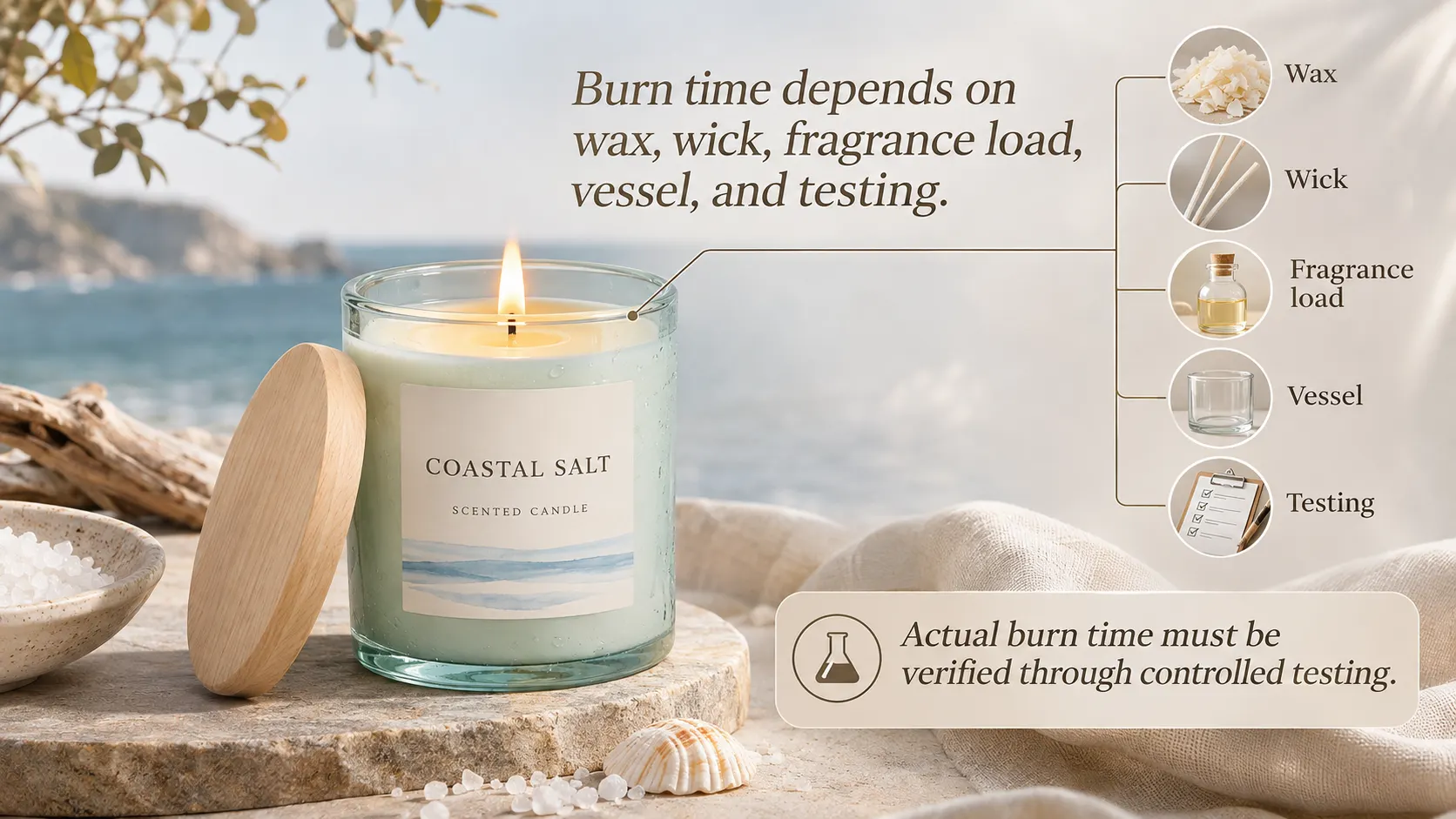
A styled editorial illustration based on the supplied Coastal Salt product reference; not a laboratory test photograph.
A scented candle's burn time is not determined by wax weight alone. It depends on how the wax, wick, fragrance, and container work together during burning.
Two candles containing the same amount of wax can have noticeably different burn times if they use different wick configurations, fragrance formulas, or container designs.
For candle brands, importers, and wholesale buyers, understanding these factors is important when comparing products, setting product specifications, and evaluating a manufacturer's burn-time claims.
The key is not simply to maximize burning hours, but to develop a candle that delivers consistent performance throughout its usable life.
Quick answer for buyers: Wax weight provides the available fuel; wick size and number influence how quickly it is consumed; fragrance and wax compatibility, vessel geometry, and test conditions affect the final result. Compare burn-time claims only when the test method and endpoint are clear.
What Does Candle Burn Time Actually Mean?
Candle burn time refers to the total time a candle burns under defined testing conditions before reaching its specified end point.
For buyers, three measurements are particularly useful:
- Net Wax Weight: The weight of the candle wax, excluding the glass vessel, lid, and packaging.
- Burn Rate: The amount of candle fuel consumed per hour, commonly expressed in grams per hour.
- Total Burn Time: The cumulative burning time measured during the product's burn test.
A basic calculation can help estimate candle burn time:
Estimated Burn Time = Usable Wax Weight ÷ Average Burn Rate
For example, if a candle contains 200 grams of usable wax and consumes an average of 4 grams per hour, its estimated burn time is 200 ÷ 4 = 50 hours.
This is a simplified estimate, not a guaranteed product specification. Actual burn rate can change throughout the candle's life, and some wax may remain when the candle reaches its defined end point.
For commercial products, published burn-time claims should be supported by testing of the finished candle. Net fill weight is not necessarily usable fuel weight: some wax may remain at the defined safe stop point. Buyers should ask how residual wax and the end point were handled when a burn-time estimate was calculated.
How Does Wax Weight Affect Candle Burn Time?
Wax weight is one of the most important factors because it determines how much candle fuel is available.
Under otherwise comparable conditions, a candle with more usable wax will generally have the potential to burn longer than one with less wax. However, comparing wax weight alone can be misleading.
Consider two hypothetical candles:
| Specification | Candle A | Candle B |
|---|---|---|
| Net wax weight | 140 g | 200 g |
| Average burn rate | 4 g/hour | 4 g/hour |
| Estimated burn time | 35 hours | 50 hours |
These figures are illustrative calculations, not UN CANDLE test results. They assume all the listed wax is usable at the stated average burn rate.
In this example, both candles have the same average burn rate, so the candle with more wax has a longer estimated burning time.
However, if Candle B uses a larger wick configuration and consumes wax faster, the difference may be smaller than expected.
Buyers should also distinguish between net wax weight and gross product weight. A heavy glass vessel does not contribute to the candle's available fuel.
When comparing wholesale scented candles, always check the actual wax weight rather than relying on the total product weight.
Buyer comparison: If two 200 g candles are offered with different claimed burn times, request their documented average burn rates, test endpoints, and wick configurations before assuming one is more efficient. A longer claim alone does not show that the product has better fragrance or safer burning performance.
Why Does Wick Selection Matter?
The wick controls how liquid wax travels toward the flame and helps determine how quickly the candle consumes its fuel.
A correctly selected wick should provide a suitable balance between flame behavior, melt pool development, and wax consumption.
An undersized wick may produce a weak flame and insufficient melting. This can lead to tunneling or excessive unmelted wax around the container.
An oversized wick may create a larger flame, excessive heat, and faster wax consumption. It may also increase soot or cause the container to become too hot.
Both situations can affect the finished candle's performance.
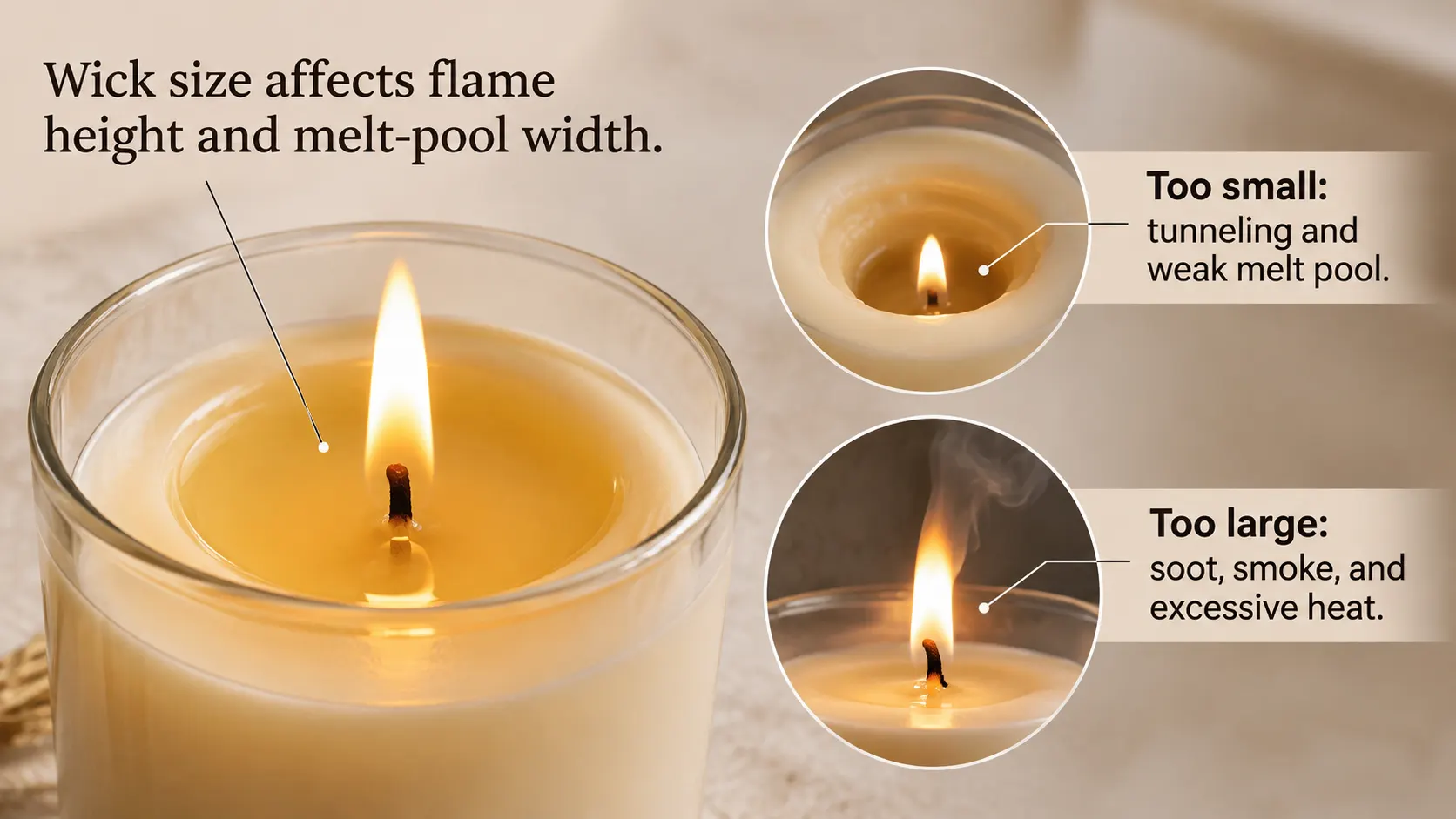
Wick selection should consider:
- Wax type and formulation
- Container diameter and geometry
- Fragrance composition and concentration
- Wick material and construction
- Single-wick or multi-wick configuration
For wider containers, multiple wicks may be considered to distribute heat across the wax surface. However, more wicks do not automatically mean a better product or a predictable reduction in burn time.
The final configuration must be established through testing. For a related comparison, see Single-Wick vs Three-Wick Candles: What Changes?.
How Do Fragrance Load and Wax Formulation Affect Burn Time?
Fragrance oil is another variable that can influence candle performance.
Different fragrance formulas have different physical properties and compatibility characteristics. Their interaction with the selected wax and wick can affect fuel delivery and burning behavior.
For example, a wick that performs well with one fragrance may not deliver the same results with another fragrance, even when the concentration is similar.
Other formulation variables may also influence performance:
- Wax type and blend composition
- Fragrance load
- Fragrance viscosity and composition
- Dye concentration
- Other formulation additives
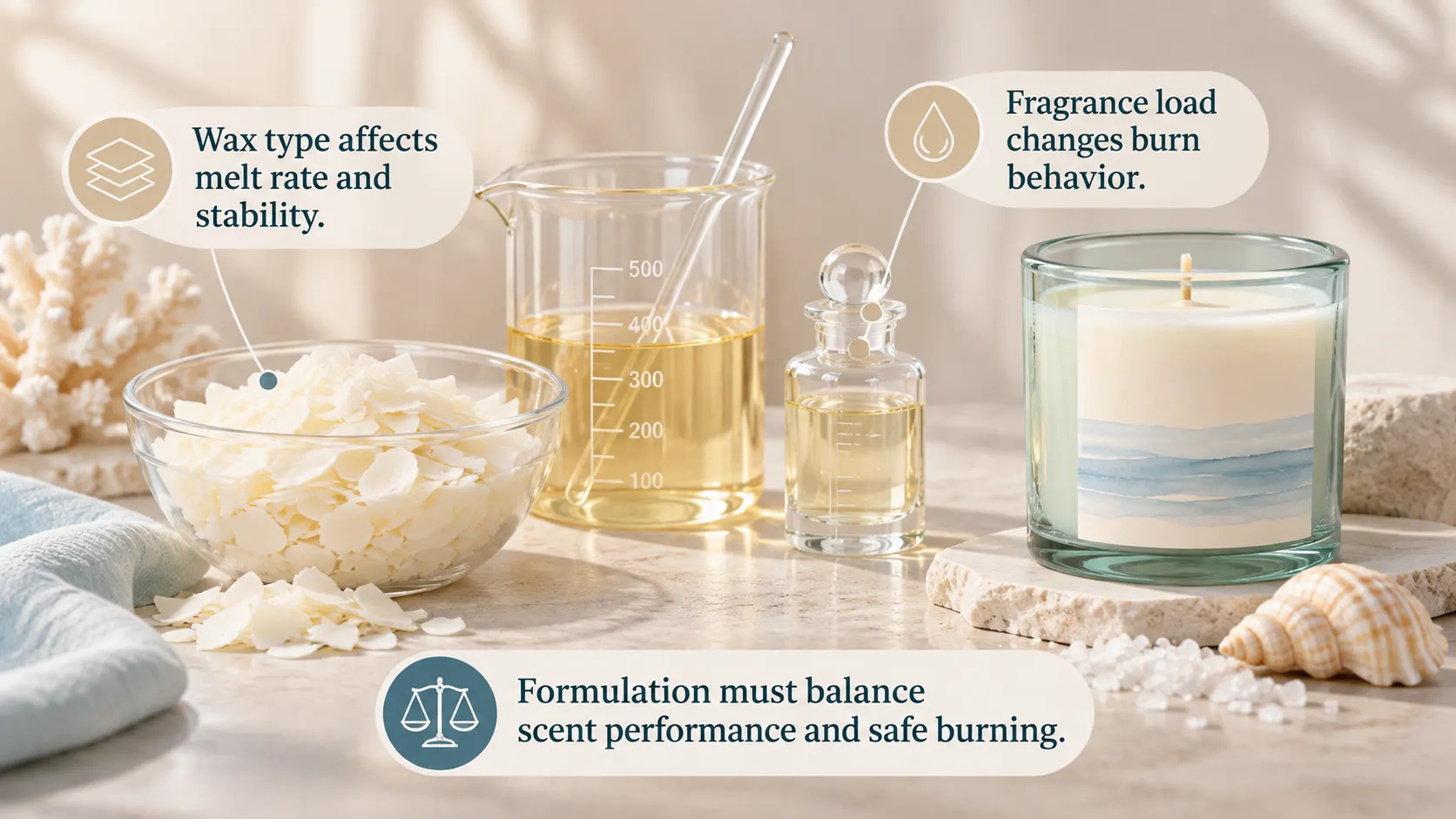
Increasing fragrance load does not automatically increase or decrease burn time by a fixed amount. The outcome depends on how the complete formula behaves during burning.
For buyers developing custom scented candles, this is why fragrance changes should be evaluated together with wick performance rather than treated as an isolated adjustment.
Related reading: Does More Fragrance Oil Make a Stronger Candle?.
Does Container Size and Shape Change Burn Time?
Yes. Container dimensions and geometry can influence how heat spreads and how the candle burns.
The internal diameter is particularly relevant because it affects the distance heat must travel across the wax surface.
A wider container may require a different wick configuration from a narrow container. A tall, narrow vessel and a wide, shallow vessel can also behave differently, even when they contain similar amounts of wax.
Other considerations include:
- Internal vessel diameter
- Container height and shape
- Glass thickness and heat-transfer characteristics
- Wick positioning
- Available space for the melt pool
For example, two candles may each contain 200 grams of wax, but one uses a relatively narrow glass jar while the other uses a wider vessel with multiple wicks.
Their burn rates may differ because their heat distribution and wick configurations are different. This is why container selection should be part of candle development from the beginning, not simply a packaging decision made after the formula is finalized.
How Do Manufacturers Measure and Verify Candle Burn Time?
A manufacturer's burn-time claim should be based on a documented testing method.
One practical approach is to measure wax consumption over repeated burn cycles:
- Record the finished candle specifications. Document net wax weight, wax formula, fragrance, wick configuration, and container dimensions.
- Weigh the candle before testing. Identify the starting mass and account for the non-burning vessel and components.
- Conduct controlled burn cycles. Burn the candle under defined conditions, recording each cycle's duration.
- Measure wax consumption. After extinguishing and cooling, weigh again; the difference estimates consumed fuel under the specified method.
- Calculate average burn rate. Divide the measured fuel consumption by actual burning hours.
- Complete the burn test. Evaluate performance over the required burning stages and to the defined test endpoint.
- Record results. Document cumulative burning time, test conditions, sample identification, endpoint, and observations.
Average Burn Rate (g/hour) = Wax Consumed (g) ÷ Burning Time (hours)
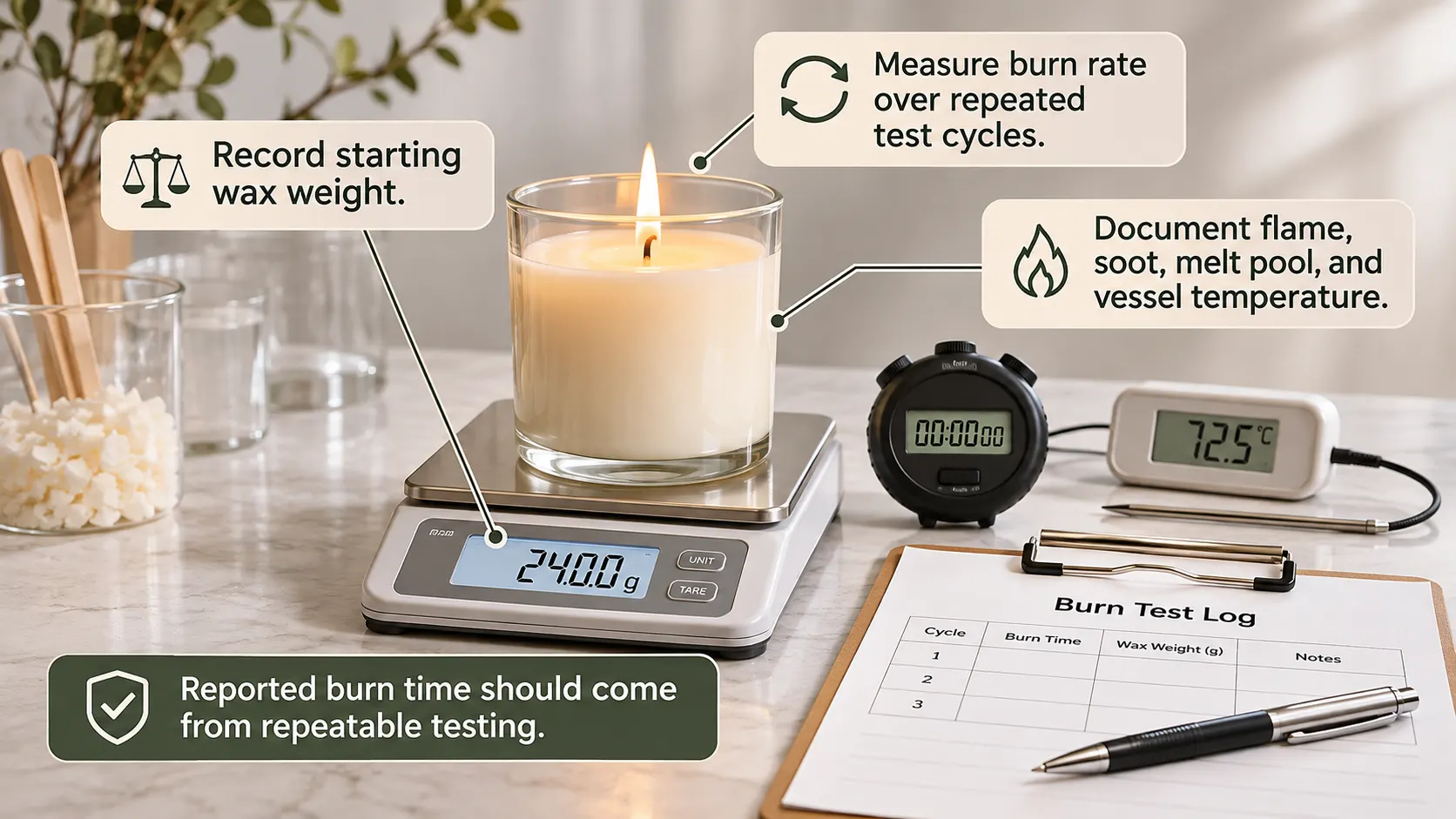
Concept illustration only. Numbers shown on equipment or paper are not actual measurements or approved burn-time claims.
A single burn cycle may not represent the entire candle's performance. Multiple cycles help account for changes in wick behavior and heat conditions as the candle burns down.
What evidence should support a burn-time claim? A buyer should be able to identify the tested SKU and formula, sample count, burn-cycle duration, measured mass loss, cumulative burn time, and the endpoint used. The published figure should match the approved final configuration; an isolated video of one burn is not a complete test record.
For a deeper examination of flame, soot, vessel safety, and testing records, see Candle Burn Testing: What Buyers Should Check.
What Should Buyers Check Before Approving a Candle's Burn Time?
When evaluating a private label or wholesale candle, buyers should request more than a single estimated number of burning hours.
| Check Item | What Buyers Should Confirm |
|---|---|
| Net Wax Weight | Actual wax weight, excluding the vessel |
| Wax Formula | Wax type and formulation |
| Wick Configuration | Wick material, size, number, and position |
| Fragrance Formula | Fragrance identity and concentration |
| Container | Internal diameter, height, shape, and material |
| Test Method | Testing conditions and burn-cycle procedure |
| Average Burn Rate | Recorded wax consumption per hour |
| Total Burn Time | Measured result and calculation method |
| End Point | Definition of when the test is considered complete |
| Production Consistency | Whether mass production follows the approved specification |
It is also important to check whether the tested sample represents the final production version.
Changing the wax, fragrance, wick, container, or other important formulation details may affect burning performance. Additional verification should be considered whenever such changes could alter the finished candle.
Practical approval rule: Compare products using the same documented criteria, and request confirmation that the quoted hours come from the final approved sample—not an earlier prototype or a generic estimate for that jar size.
Developing Scented Candles With UN CANDLE
A longer burn time is not automatically a sign of a better candle.
For brands developing a wholesale or private label collection, the goal is to balance wax weight, wick selection, fragrance performance, container design, and product safety.
At UN CANDLE, we support OEM and ODM scented candle development, including wax and wick selection, fragrance customization, vessel options, sample development, and bulk production.
Whether you are developing a compact glass jar candle or a larger multi-wick design, the finished product should be evaluated as a complete system.
If you are planning a new candle collection, share your preferred vessel dimensions, target wax weight, fragrance direction, wick configuration, and estimated order quantity with our team. We can discuss suitable product specifications and sample development options for your project.